

What Should You Do After a Dental Injury? An Emergency Dentist's Guide in Singapore

A dental injury never happens at a convenient time. It might be a bitten piece of ice at dinner, a fall during football training, or a knock to the mouth on the bike ride home. In the first few minutes, most people aren't thinking about teeth at all. They're thinking about pain, blood, shock. But here's the thing: those first minutes can genuinely affect how a tooth recovers. So it helps to know, calmly and in advance, what to actually do.
The tricky part is that not every dental injury needs the same response. A hairline chip is not the same emergency as a tooth knocked clean out of its socket. Knowing which situation you're actually dealing with, and how urgently you need to act, is often the difference between saving a tooth and losing it. This guide from The Endodontic Office walks through how to work out what you're facing and what to do about it, whether you're near our practice in Singapore or reading this to prepare for the unexpected.
Why the First Few Minutes Matter
Teeth are held in place by a network of ligament fibres and a blood supply that can, in some cases, be preserved if treated quickly. This is particularly true for a knocked-out tooth, where the window for successful re-implantation is measured in minutes, not hours. For less severe injuries, like small chips or cracks, there's more time to think. But ignoring symptoms can still let bacteria reach the inner pulp of the tooth, and that leads to infection later on.
So the first real decision point is this: how severe does this injury actually look and feel? That single judgement call shapes everything that follows.
Signs That Point to a Genuine Emergency
Some signals mean you need to see an emergency dentist in Singapore as soon as possible, rather than waiting for a routine appointment:
- The tooth is completely out of the socket.
- A tooth is visibly loose or shifted out of position.
- There's a deep crack that reaches below the gumline.
- Bleeding from the gum area won't stop after gentle pressure.
- A fragment of tooth is missing, and there's sharp pain when biting or breathing in cold air.
If any of these apply, treat it as urgent. Got mild sensitivity instead? A small chip with no pain, or slight soreness that settles within a day? Still worth being assessed, but it's less likely to be a same-day emergency.
Knocked-Out Tooth Treatment in Singapore: What To Do First
A fully knocked-out (avulsed) tooth is one of the few dental situations where minutes genuinely count. Here's how to approach it:
- Pick the tooth up by the crown (the biting surface), not the root. The root surface carries delicate ligament cells that need to stay intact.
- If the tooth is dirty, rinse it briefly with milk or saline, not tap water. Don't scrub it. Don't wrap it in tissue.
- Try to reinsert the tooth gently back into its socket if you can do it without forcing it, then bite down softly on a clean cloth to hold it in place.
- If reinsertion isn't possible, keep the tooth in a small container of milk, saline, or the injured person's own saliva. Avoid plain water. It damages the root surface cells.
- Get to an emergency dentist as fast as you can, ideally within 30 to 60 minutes.
Truth is, outcomes vary depending on how the tooth was stored, how long it was out of the mouth, and the extent of any damage to the root. Not every knocked-out tooth can be saved. But prompt action gives it a reasonable chance.
Broken Tooth Emergency in Singapore: Working Out How Serious It Is
Not all broken teeth are equal, and this is where the "how do you know which situation you're in" question really matters.
- A minor chip, where only the enamel is affected and there's no sensitivity or pain, is uncomfortable but usually not urgent. Rinse with warm water, cover any sharp edges with dental wax if you have it, and book an appointment within a few days.
- A moderate break is a different story. If the tooth is sensitive to temperature or pressure, or there's a visible layer of yellowish dentine exposed, it needs attention sooner, ideally within 24 hours, since the inner tissue is closer to being exposed to bacteria.
- A severe break, where there's a pink tinge or visible bleeding at the centre of the tooth, sharp ongoing pain, or a large piece missing, is a genuine emergency. This often means the nerve inside the tooth (the pulp) has been exposed. It's a situation an endodontic-focused dental practice sees regularly, since it may need root canal treatment to preserve the tooth.
Not sure which category you fall into? Call the clinic and describe what you're seeing. A member of the team can usually help you judge the urgency over the phone before you travel in.
What Helps in the Meantime
While waiting to be seen, a cold compress against the cheek can reduce swelling, and over-the-counter pain relief can help manage discomfort. Avoid chewing on the affected side. Steer clear of very hot or cold food and drink, which can aggravate an already sensitive tooth.
When a Dental Injury Involves More Than the Tooth
Sometimes an injury also affects the lip, gum, or jaw. If there's significant swelling, difficulty opening the mouth fully, or any suspicion the jaw itself may be fractured, this moves beyond what a dental clinic alone can manage. A visit to a hospital accident and emergency department may be needed alongside dental care. It's not about choosing one over the other. It's about recognising when both are relevant.
Ready to Get Started?
Dental injuries are stressful, and it's completely normal not to know exactly what you're dealing with in the moment. If you're near our practice in Singapore and you've had a knocked-out tooth, a broken tooth, or any injury to your mouth, contact The Endodontic Office as soon as you can. Our team has a special interest in saving natural teeth wherever possible, and being seen promptly gives your tooth the best chance available given its specific circumstances. Call ahead if you can, so we can guide you on immediate care while you make your way to us.
FAQs
Q. How long can a knocked-out tooth survive outside the mouth?
A. There's no fixed guarantee, but generally, the sooner the tooth is reinserted or brought to a dentist, the better its chances. Keeping it moist in milk or saliva and getting to a clinic within 30 to 60 minutes gives it a reasonable shot at being treated successfully.
Q. Should I go to a hospital or a dental clinic for a broken tooth?
A. For an isolated broken or knocked-out tooth without jaw injury, an emergency dentist in Singapore is usually the right first point of contact, since dental clinics have the specific tools and materials needed for tooth-related trauma.
Q. Can a chipped tooth wait until a regular appointment?
A. A small, painless chip can often wait a few days. Still worth having it checked, though, since untreated sharp edges can cut the tongue or cheek, and hidden cracks aren't always visible without an examination.
Q. What if I cannot find the knocked-out tooth at all?
A. If the tooth can't be located, still see a dentist promptly. The socket and surrounding gum need to be assessed, and depending on the situation, replacement options can be discussed.
Q. Will a root canal be needed after a dental injury?
A. Not always. It depends on whether the injury has reached the inner pulp of the tooth. This gets assessed during examination, sometimes with an X-ray, and treatment is only recommended when there's clinical evidence it's needed.
Our Locations
Multiple locations, one trusted team. Expert endodontic care wherever you are.
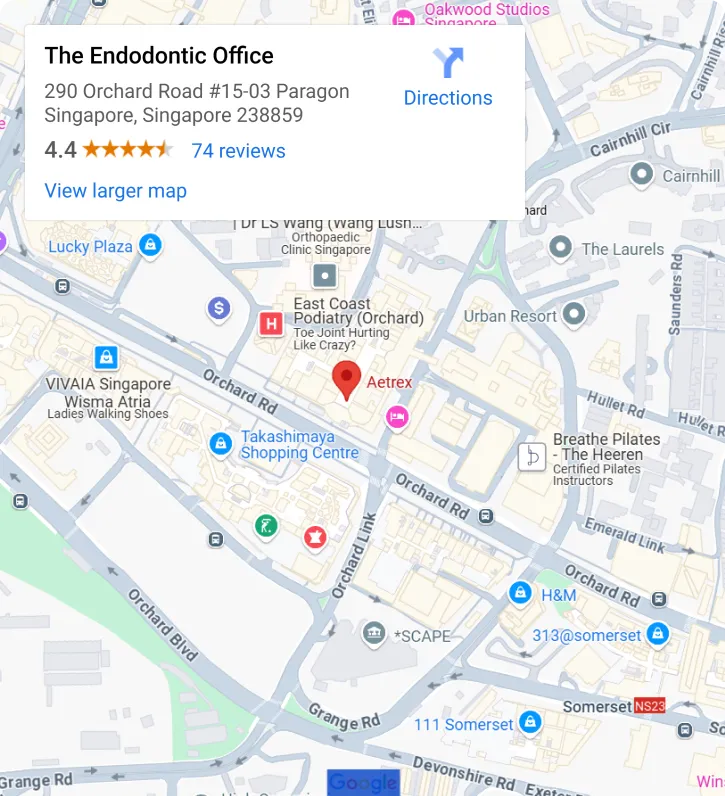


Orchard, Paragon Medical
Address: 290 Orchard Road, #15-03, Paragon, Singapore 238859
Phone: +65 6734 7790
WhatsApp: +65 9782 8446
Email: appointment@endooffices.com

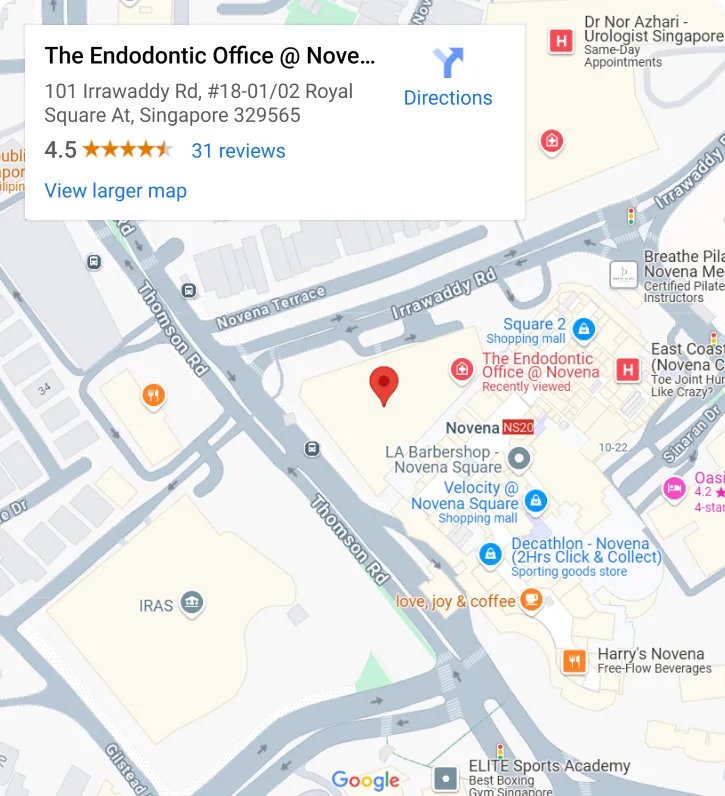
Novena, Royal Square Medical Centre
Address: 101 Irrawaddy Road, #18-01/02, Royal Square, Singapore 329565
Phone: +65 6259 3100
WhatsApp: +65 8078 9638
Email: appointment@endooffices.com

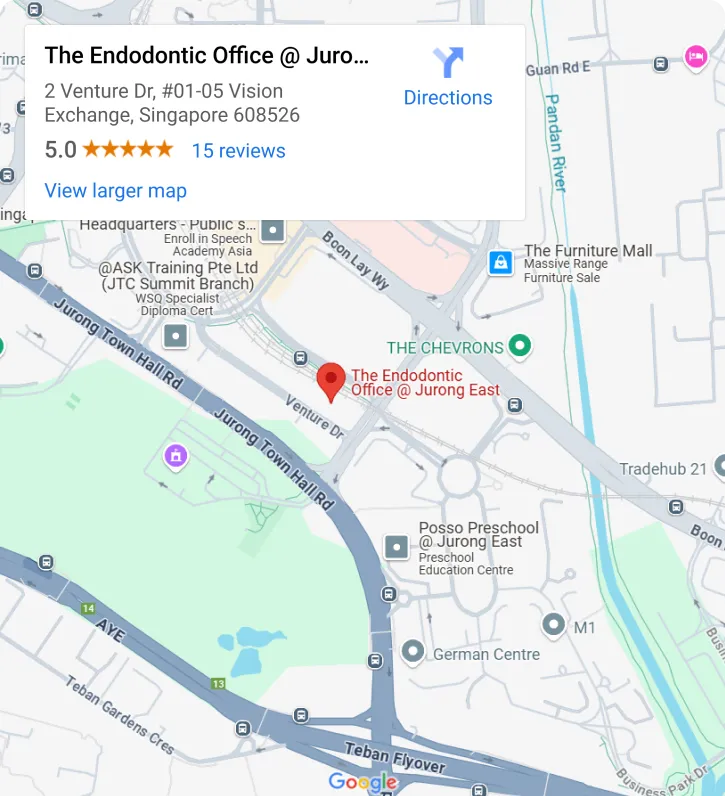
Jurong East, Vision Exchange
Address: 2 Venture Drive, #01-05, Vision Exchange, Singapore 608526
Phone: +65 6874 7790
WhatsApp: +65 8076 1813
Email: appointment@endooffices.com
The Endodontic Office is a trusted specialist dental practice in Singapore focused on advanced root canal treatment, effective dental pain relief, and preserving natural teeth through modern technology and expert care.

©2026 The Endodontic Office | All Rights reserved | Privacy Policy | Digital Marketing by Remedo