

Root Canal vs Tooth Extraction: Which Is Better for You?

Dealing with severe tooth pain, deep decay, or a broken tooth can cause a lot of worry. When a tooth is badly damaged or infected, you are usually faced with an important choice. You will need to decide whether to have a root canal treatment or to get the tooth taken out completely. Making this choice means balancing how to stop the pain quickly with what is best for your mouth, your chewing, and your future dental needs.
This guide gives you a plain, factual comparison between these two common dental procedures. Understanding how each treatment works and what happens afterward will help you when you speak to your dentist. Whether you visit a dental clinic in Singapore or see a professional elsewhere, knowing the facts helps you make a choice that supports your long-term health.
What is a Root Canal Treatment?
A root canal treatment is a normal dental procedure used to save a natural tooth that has been badly damaged by an infection or deep decay. When the soft tissues inside the tooth become inflamed or die, a root canal works to clean out the problem area while keeping the outside of your tooth in place.
The Process of Saving a Tooth
The treatment usually starts with a local anaesthetic to numb the area around the tooth. This helps to keep you comfortable during the visit. Once the tooth is completely numb, the dentist makes a small opening in the top part of the tooth to reach the inside. Using small, precise instruments, the professional removes the infected or dead tissue from the root canals.
After the canals are cleaned, washed out, and shaped, they are filled with a safe material called gutta-percha. This material seals up the empty spaces so that bacteria cannot get back inside and cause another infection. Finally, the opening is closed with a regular filling. In most cases, a dental crown is placed over the tooth later on to make it strong again and to stop it from splitting when you chew your food.
When a Root Canal is Recommended
A root canal is generally needed when the soft inner pulp of a tooth is damaged beyond repair, but the root itself is still strong and healthy. This problem often happens if you have a deep cavity that has reached the nerve, a deep crack in the tooth, or an injury from a sudden blow to the face. Common signs that you might need a root canal include a constant, throbbing ache, extra sensitivity to hot and cold things that stays even after you finish your drink, swelling in your gums, or a tooth that has started to turn a darker colour.
What is a Tooth Extraction?
A tooth extraction simply means removing a tooth completely from its socket in the jawbone. While dentists always try to keep your natural teeth whenever they can, there are times when a tooth is too badly broken to be fixed, and taking it out is the most practical choice.
The Process of Removing a Tooth
Taking a tooth out can be done in two different ways, depending on the condition of the tooth. A simple extraction is done on a tooth that can be seen easily in the mouth. The dentist uses tools to loosen the tooth from the bone and the surrounding tissue before lifting it out.
A surgical extraction is needed if the tooth has broken off right at the gumline or if it has not pushed through the gum fully, which often happens with wisdom teeth. In this situation, the dentist needs to make a small cut in the gum to reach and remove the tooth safely. Just like a root canal, this procedure is done using a local anaesthetic so you do not feel pain while the tooth is being removed.
When an Extraction is Necessary
An extraction is recommended when a tooth is damaged so badly that regular repairs cannot save it. This includes times when a crack splits the root vertically down under the gum, or when decay has eaten away so much of the tooth that there is not enough left to hold a crown. Severe gum disease, which destroys the bone that keeps your teeth steady, can also make teeth very loose, meaning they need to be taken out. Extractions are also sometimes used during brace treatments to make more room in a crowded mouth.
Comparing Root Canal Treatment and Tooth Extraction
To understand the differences between these two choices, it helps to look at how they compare across everyday practical areas without looking at a complex chart.
The primary goal of a root canal is to keep your own tooth structure in your mouth, while an extraction removes the tooth entirely. In terms of time, a root canal usually takes one or two visits to complete properly, whereas an extraction is normally done in a single appointment. However, the healing process is quite different. After a root canal, you might have some mild soreness for a few days, but you can go back to your normal routine quickly. With an extraction, the bone and the gum socket leave an open wound that takes several weeks to heal completely.
In the long run, a root canal keeps your natural bite aligned because the tooth stays where it belongs. If you choose an extraction, you will eventually need to think about getting a replacement tooth, such as an implant or a bridge, to stop your other teeth from moving out of place. This means that while taking a tooth out might seem quicker at the start, it often leads to more decisions and treatments down the road.
Long-Term Considerations for Your Oral Health
When you are choosing between a root canal and an extraction, it is important to think about the future, not just how to stop the pain today. Your choice can affect how you chew, how your other teeth move, and your future dental bills.
The Value of Natural Teeth
Keeping your own teeth has a lot of health benefits. Natural teeth are held in place by a tiny ligament that acts like a built-in shock absorber when you bite down. This helps you chew all types of food easily and comfortably.
Keeping your natural tooth root also helps your jawbone stay healthy. The root sends signals to the bone when you chew, which keeps the bone strong. When a tooth is taken out, the bone underneath no longer gets these signals, and it can slowly shrink over time. If you lose several teeth and the bone shrinks, it can eventually change your face shape and make your lips or cheeks look a bit sunken.
Replacing an Extracted Tooth
If you choose to have a tooth taken out, it is usually a good idea to fill the empty space later on. Leaving a gap can cause the teeth next to the space to slowly tip and drift into the open area. This can ruin your bite and make those teeth harder to clean properly with a toothbrush or floss.
Replacing a missing tooth usually involves treatments like dental implants, dental bridges, or partial dentures that you can take out. While these replacement options work well, they require their own separate treatments and need regular care over the years. Because of this, saving your tooth with a root canal can often be a simpler and more straightforward approach than removing it and paying for an artificial replacement.
Discuss Your Options with The Endodontic Office
If you are suffering from tooth pain or are not sure if your tooth can be fixed, getting a professional check is the best thing to do. The Endodontic Office provides assessments for patients dealing with tooth aches, deep infections, and damaged teeth. Visiting a dental clinic in Singapore allows you to get a clear check, see your dental x-rays, and find out about the choices available for your specific problem. You can contact our team to book a consultation, where we will examine your tooth and give you factual information to help you look after your smile.
Frequently Asked Questions (FAQs)
Is a root canal more painful than getting a tooth taken out?
With modern treatments and local numbing medicine, a root canal is usually no more painful than getting a regular filling. The main point of the treatment is actually to get rid of the infection that is causing your toothache. You might feel some mild soreness for a few days afterward, which you can manage easily. An extraction is also painless while the tooth is being removed because of the numbing, but afterward, you have an open socket in your gum that can take longer to heal and can cause some discomfort.
How long does a tooth last after a root canal?
If you take good care of it and get a proper filling or a dental crown placed on top, a tooth that has had a root canal can last for many years. Many of these teeth last for the rest of your life. You just need to keep up good habits, like brushing twice a day and flossing, to protect the remaining tooth from new decay.
What happens if I just leave a gap after an extraction?
If you leave a gap and do not replace the tooth, your other teeth can slowly shift and tilt into the empty space. This can change the way your top and bottom teeth meet when you chew, putting extra stress on your remaining teeth. It can also create awkward gaps where food gets trapped, raising your risk of gum disease and decay.
Can every single tooth be saved by a root canal?
No, not every tooth can be saved. If a crack goes straight down the root under the gumline, if the tooth is very loose because of severe gum disease, or if decay has destroyed too much of the tooth structure, a root canal will not work. In these cases, taking the tooth out and looking at a replacement is the right choice.
How many times do I need to visit the dentist for a root canal?
Most of the time, a root canal takes one or two appointments. The number of visits depends on how many canals the tooth has, how bad the infection is, and the shape of the roots. Front teeth usually have only one canal and can be done quickly, while back molars have multiple canals and can take longer to clean out.
What is a dry socket after an extraction?
A dry socket is a common issue that can happen after a tooth is removed. It occurs if the blood clot that forms in the empty socket fails to develop properly or gets washed away before the wound heals. This leaves the bone and nerves exposed to the air and food, which can be quite painful. Your dentist can treat this easily by placing a soothing dressing over the area.
Our Locations
Multiple locations, one trusted team. Expert endodontic care wherever you are.
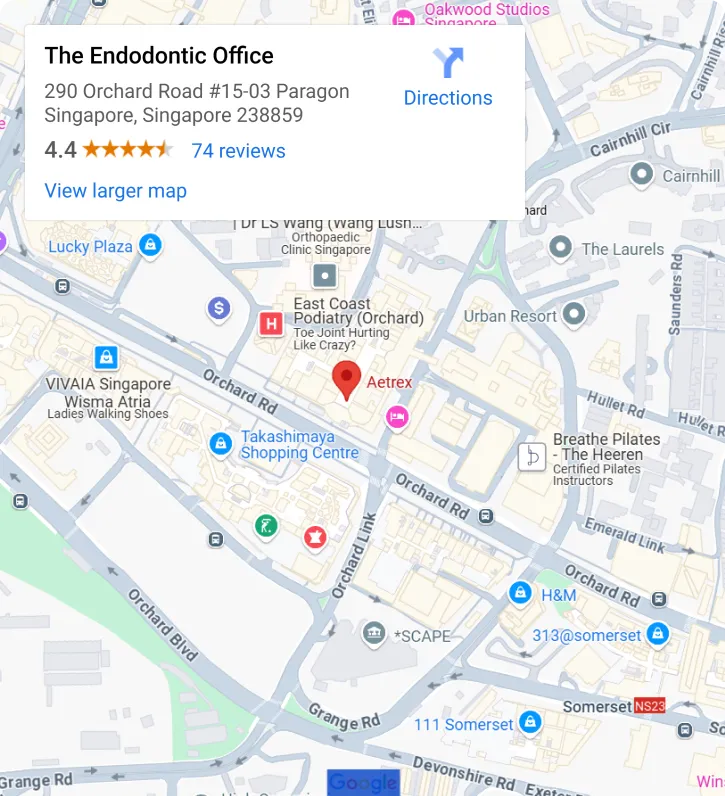



Orchard, Paragon Medical
Address: 290 Orchard Road, #15-03, Paragon, Singapore 238859
Phone: +65 6734 7790
WhatsApp: +65 9782 8446
Email: appointment@endooffices.com

Novena, Royal Square Medical Centre
Address: 101 Irrawaddy Road, #18-01/02, Royal Square, Singapore 329565
Phone: +65 6259 3100
WhatsApp: +65 8078 9638
Email: appointment@endooffices.com

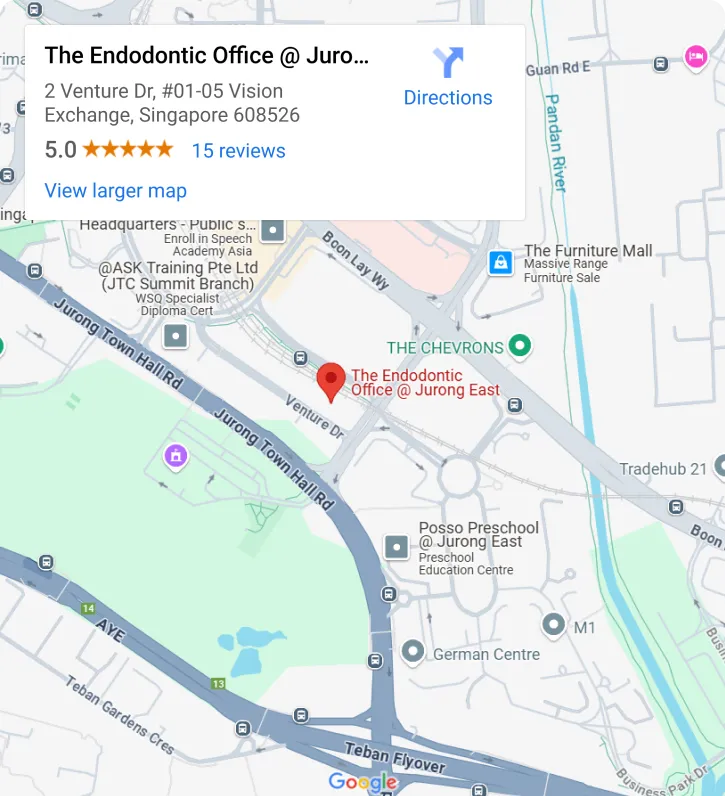
Jurong East, Vision Exchange
Address: 2 Venture Drive, #01-05, Vision Exchange, Singapore 608526
Phone: +65 6874 7790
WhatsApp: +65 8076 1813
Email: appointment@endooffices.com
The Endodontic Office is a trusted specialist dental practice in Singapore focused on advanced root canal treatment, effective dental pain relief, and preserving natural teeth through modern technology and expert care.

©2026 The Endodontic Office | All Rights reserved | Privacy Policy | Digital Marketing by Remedo