

How Long Does Pain Last After a Root Canal? What to Really Expect

If you just finished a root canal, or if you have one coming up, the first thing you are probably looking for is relief. You have likely been dealing with a bad toothache for a while, and you are ready for the problem to be over. But as the numbness wears off after your visit, it is normal to wonder: "Is it supposed to feel like this? How long will this last?"
At The Endodontic Office, we know these treatments have a scary reputation. But the truth is, the procedure is done to stop pain, not cause it. Most of the bad stories people tell come from the tooth infection they had before they even got to the dentist.
Still, your body just went through a medical procedure, so you will have some questions. Let’s talk about the healing timeline, what is normal, and when you should give us a call at The Endodontic Office.
Right After the Visit: The First 24 Hours
When you leave The Endodontic Office, you will still be numb for a few hours. Once that wears off, you will probably feel some tenderness in the area.
That "Bruised" Feeling
Think of a root canal like a small surgery for your tooth. We cleaned out the tiny spaces inside the root, and the tissue around the tooth—the bone and ligaments—will be a little irritated. Most patients say this feels like a dull ache or a "bruised" feeling rather than the sharp, stabbing pain they had before.
Jaw Soreness
It is also very common for your jaw to feel stiff. You had to keep your mouth open for a while, and the spot where the numbing medicine was injected might be a bit sore. This usually goes away in a day or two.
The Recovery Timeline: Day by Day
Everyone heals at a different speed, but there is a general pattern we see here at The Endodontic Office.
Days 1 to 3: The Most Sensitive Time
The first three days are usually when you feel the most discomfort because the inflammation is at its peak. You might feel a sharp pinch if you accidentally bite down on that tooth. This is why we tell our patients to avoid chewing on that side until they get their permanent crown.
Days 4 to 7: Getting Better
By the fourth day, you should notice a big drop in sensitivity. You might still "notice" the tooth is there, but you shouldn't need to take pain medicine as often. If the pain is still as bad on day five as it was on day one, give The Endodontic Office a call.
After One Week: Feeling Normal
Within a week, most patients forget they even had work done. The area should feel calm and the gums shouldn't be sore anymore. At this point, you are just waiting for your follow-up visit to get your permanent tooth cover.
Why Does a Root Canal Tooth Hurt if the Nerve is Gone?
This is a question we hear a lot: "If you took the nerve out, why can I still feel it?"
It’s a great question. While the nerve inside the tooth is gone, the tooth is still sitting in a socket filled with nerves and blood vessels. Those are the tissues you are feeling. The ligaments holding the tooth in place are often swollen from the old infection, and they take a little time to calm down.
At The Endodontic Office, we compare it to pulling out a splinter. Even after the splinter is gone, your finger stays red and sore for a few days. Your tooth works the exact same way.
Tips for Staying Comfortable at Home
You don't have to just sit there and hurt. There are easy ways to feel better while you heal.
Over-the-Counter Medicine
For most people, taking Ibuprofen (like Advil) and Acetaminophen (like Tylenol) works really well. Studies show that taking these two together can work better than stronger prescription pills. Just make sure to follow the directions from the team at The Endodontic Office.
Salt Water Rinses
If your gums feel irritated where the numbing shot was given, a warm salt water rinse can help. It keeps the spot clean and helps the swelling go down.
Soft Foods
Stick to soft foods for the first few days. Things like smoothies, yogurt, mashed potatoes, or soup are best. Avoiding hard or crunchy foods keeps you from putting too much pressure on the tooth while it heals.
Frequently Asked Questions
Q: Why does the tooth feel "different" to my tongue?
A: We usually put a temporary filling in the tooth after a root canal. This material is a bit rougher than your natural tooth and might wear down a little. As long as it hasn't fallen out completely, you are fine.
Q: What if my cheek is swelling?
A: A little soreness in the gums is normal, but if you see actual swelling in your face or a "pimple" on your gums, we need to know. If you get a fever or a bad taste in your mouth, call The Endodontic Office right away.
Q: Can I go back to work the same day?
A: Most people can! Unless you had a very strong sedative, you should be able to drive and go about your day. You might just want to avoid any big meetings where you have to talk a lot while you are still numb.
Q: Why does it hurt more when I lie down?
A: When you lie flat, more blood flows to your head. This can make a throbbing tooth feel stronger. Try using an extra pillow to keep your head propped up for the first night or two.
When to Call The Endodontic Office
While some soreness is expected, there are a few "red flags" to look out for. Please call us if:
- The pain is so bad that medicine doesn't help.
- You see swelling inside or outside your mouth.
- You have a reaction to your medicine, like a rash.
- Your bite feels uneven or "high."
- The temporary filling falls out.
We are here to help you. We would much rather have you call us with a question than sit at home and worry. At The Endodontic Office, your comfort is our main goal.
The Big Picture: Success and Care
The good news is that root canals work very well—over 95% of the time. Once the healing is done, that tooth can last for the rest of your life.
Just remember, the root canal is only the first part. You have to go back to your regular dentist to get a permanent crown. A tooth that has had a root canal is more brittle and can crack if it isn't protected. Don't skip that last step!
Why See a Specialist?
Some people wonder if they should see their regular dentist or an endodontist. An endodontist is a specialist who has two or three years of extra training just for saving teeth.
At The Endodontic Office, we use microscopes and advanced tools that help us see things that are hard to find with the naked eye. This helps us treat the infection more thoroughly, which usually means less pain and a faster recovery for you.
Ready to Feel Better?
If you are in pain now or were told you need a root canal, don't wait. The longer an infection stays there, the harder it is to treat.
Give us a call at The Endodontic Office today. We will listen to you, explain how everything works, and help you get back to feeling like yourself. You don't have to live with a toothache.
Our Locations
Multiple locations, one trusted team. Expert endodontic care wherever you are.
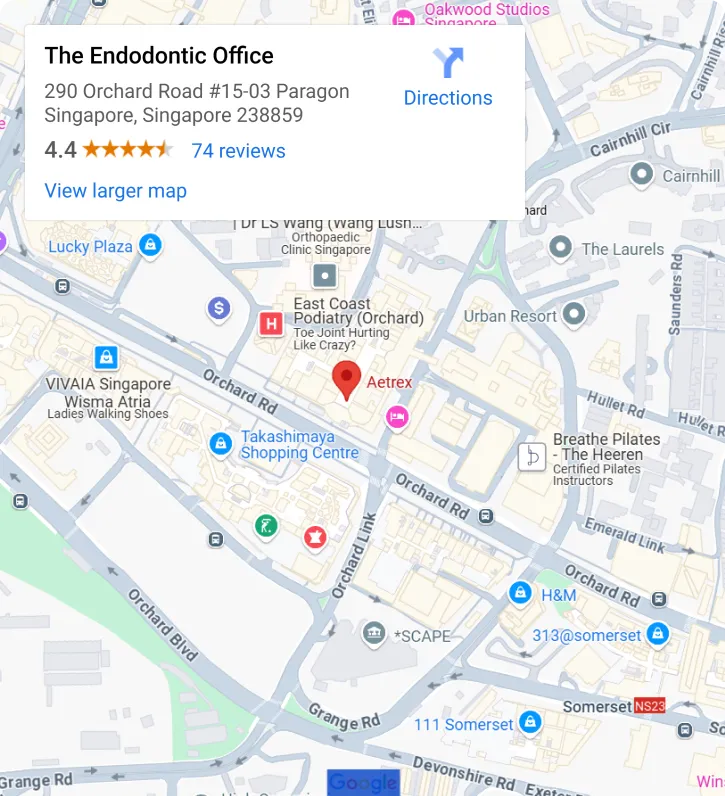


Orchard, Paragon Medical
Address: 290 Orchard Road, #15-03, Paragon, Singapore 238859
Phone: +65 6734 7790
WhatsApp: +65 9782 8446
Email: appointment@endooffices.com

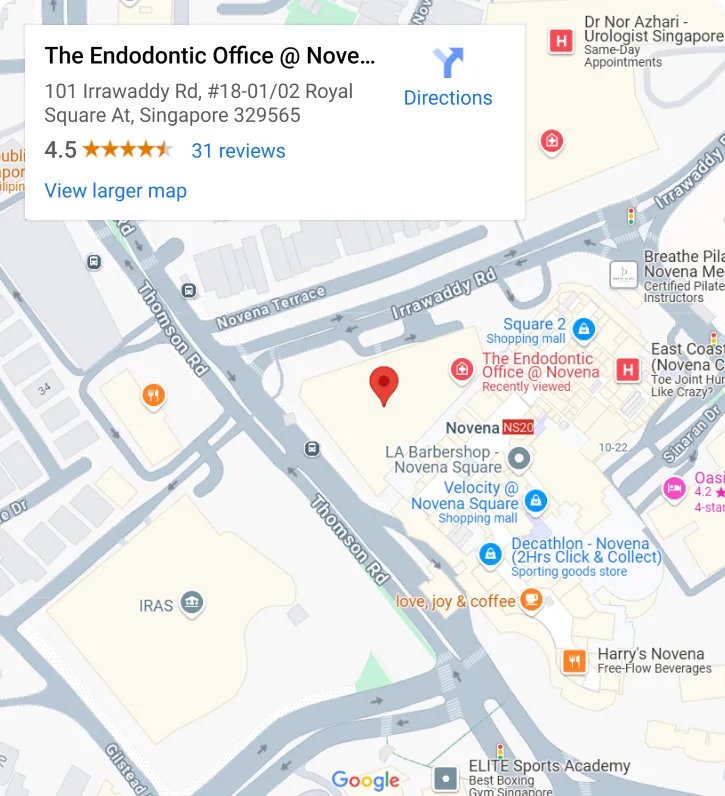
Novena, Royal Square Medical Centre
Address: 101 Irrawaddy Road, #18-01/02, Royal Square, Singapore 329565
Phone: +65 6259 3100
WhatsApp: +65 8078 9638
Email: appointment@endooffices.com

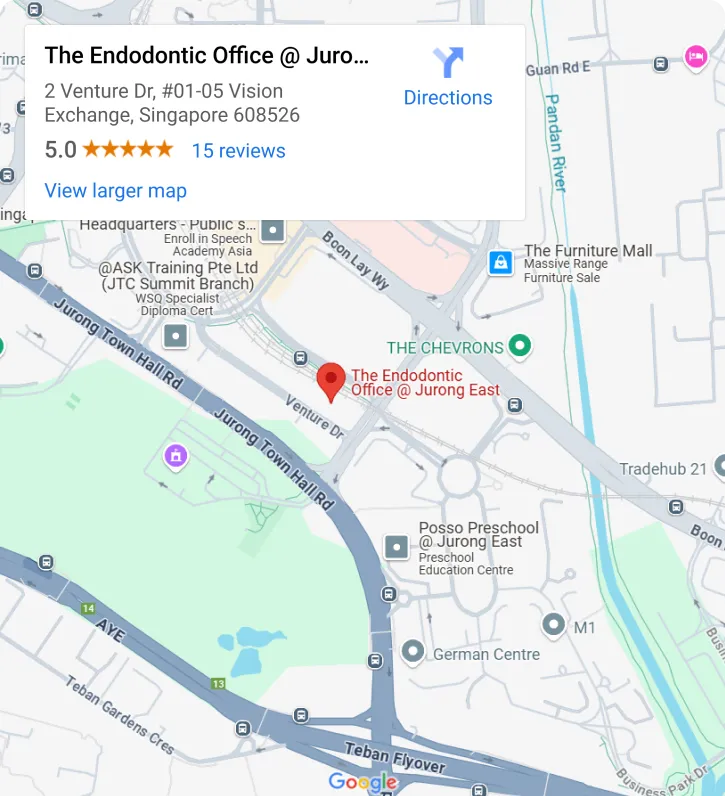
Jurong East, Vision Exchange
Address: 2 Venture Drive, #01-05, Vision Exchange, Singapore 608526
Phone: +65 6874 7790
WhatsApp: +65 8076 1813
Email: appointment@endooffices.com
The Endodontic Office is a trusted specialist dental practice in Singapore focused on advanced root canal treatment, effective dental pain relief, and preserving natural teeth through modern technology and expert care.

©2026 The Endodontic Office | All Rights reserved | Privacy Policy | Digital Marketing by Remedo