

7 Signs Your Root Canal May Have Failed and When You Need Retreatment
A root canal is meant to settle things down. The pain that sent you into the dental chair should ease off. The tooth should feel calm again, and life should go back to normal within a week or two. Most of the time, that's exactly what happens. But sometimes a treated tooth starts acting up again, weeks, months, or even years later, and you're left wondering whether that's just normal healing or a sign something's gone sideways.
At The Endodontic Office, we see this fairly often. People come in confused because they assumed a root canal was a one-and-done fix, so when discomfort returns, it feels like a step backwards. Learning the failed root canal symptoms to watch for, and knowing what actually happens during an assessment, takes a lot of the guesswork out of it.
Why a Root Canal Can Fail in the First Place
Before we get into the warning signs, it helps to understand why treated teeth sometimes don't hold up. A root canal removes infected or inflamed pulp tissue from inside the tooth, then seals the canals to keep bacteria out. Failure usually comes down to one of a few things: canal anatomy that's more complex than it looked and wasn't fully cleaned the first time round, a new crack letting bacteria back in, a crown or filling that no longer seals properly, or reinfection that creeps in over time even after solid, technically sound treatment.
None of this means the original treatment was done carelessly. Tooth roots can have canals that branch or curve in ways that are genuinely hard to spot, even with good technique. This is exactly why retreatment exists as its own area of care.
Step One: Noticing the Symptoms
The first stage of figuring out whether a root canal has failed is simply paying attention to what your tooth is telling you. Here are the seven signs we ask about most.
1. Pain That Returns After Initially Settling
Tooth pain after root canal treatment should improve steadily over days. If it fades and then comes back weeks or months later, that's worth investigating. Not ignoring.
2. Sensitivity to Heat or Pressure
A treated tooth generally shouldn't react much to hot food, cold drinks, or biting pressure once healing is done. Renewed sensitivity, particularly to heat, can point to lingering infection.
3. Swelling in the Gum Near the Tooth
A small bump or persistent swelling close to the treated tooth is often infection trying to drain. It doesn't always hurt. That's exactly why people miss it.
4. A Pimple-Like Bump on the Gum (Sinus Tract)
Related to the swelling above, but worth calling out on its own. A bump that comes and goes, sometimes with a bad taste when it drains, usually means there's an infection source that hasn't fully cleared.
5. Discomfort When Chewing on That Side
If biting down keeps causing an ache around a previously treated tooth, it may mean a crack, a loose filling, or bacteria that have found their way back into the canal system.
6. Discolouration of the Tooth
Teeth that have had root canal treatment can darken over time. Mild discolouration on its own isn't automatically a red flag. But a tooth that changes colour alongside other symptoms is worth a closer look.
7. Changes Visible on an X-ray
Sometimes there are no symptoms at all. The first clue is something your dentist spots on a routine X-ray, like a dark area around the root tip suggesting inflammation or infection.
Step Two: Getting an Accurate Assessment
Sound familiar? If any of the above rings a bell, the next step is a proper clinical assessment, not guessing at home. At The Endodontic Office, that typically starts with a conversation about your symptoms and dental history, followed by an examination and imaging.
We often use cone-beam CT scanning at this stage, because standard two-dimensional X-rays don't always show the full picture. A 3D scan can reveal a missed canal, a crack in the root, or an area of infection that a flat image might miss completely. This step matters. It shapes whether retreatment, surgery, or a different approach altogether is the right path forward.
Step Three: Weighing Up the Options
Once we understand what's actually going on inside the tooth, the conversation turns to options. Retreatment means reopening the tooth, removing the old filling material from the canals, clearing out any infection, and resealing everything, sometimes checking for canals that may have been missed the first time round. It's a more involved procedure than a first-time root canal, partly because the tooth's already been worked on once. But it's often a reasonable way to save a tooth that would otherwise need pulling.
In some cases, retreatment just isn't suitable. Maybe there's a vertical root fracture, or the canal anatomy makes non-surgical access unworkable. In those situations, we might discuss an apicoectomy (a minor surgical procedure that treats the root tip directly), or, if the tooth truly can't be saved, extraction with options for replacement. We won't pretend every tooth can be kept. But we do aim to give you a realistic picture of what's achievable before deciding on a plan.
Step Four: What Retreatment Actually Involves
For anyone considering retreatment, it helps to know roughly what's coming. The appointment usually starts with local anaesthetic, much like the original treatment. The old filling material is removed from the canals using specialised instruments, the canals are cleaned and disinfected thoroughly, and any previously missed anatomy gets checked using magnification and imaging. Once the canals are properly prepared, they're resealed, and the tooth is restored, often with a new crown if the old one needs replacing.
Recovery tends to follow a similar pattern to a first root canal: some tenderness for a few days, manageable with over-the-counter pain relief, and a gradual return to normal chewing. Because it's a second procedure on the same tooth, we keep a close eye on healing with follow-up reviews and imaging over the following months.
When to See a Root Canal Specialist in Singapore
Not every bit of post-treatment discomfort needs specialist input straight away. But persistent or recurring symptoms are worth having checked properly rather than waiting them out. If your regular dentist has flagged a possible failed root canal, or you've noticed several of the signs above, getting an endodontic assessment can clarify what's actually happening, and what your options are, before things progress further.
Ready to Get Started?
If a previously treated tooth is giving you trouble again, get it looked at properly. Don't just hope it settles on its own. The team at The Endodontic Office can assess the tooth, walk you through what the imaging shows, and explain the realistic options for your specific situation. Get in touch with The Endodontic Office to arrange an assessment and find out what's really going on with your tooth.
FAQs
Q. How long after a root canal can failure occur?
A. It varies. Some failures show up within months, others take years to surface. Regular check-ups help catch changes early, often before you feel a thing.
Q. Is retreatment as painful as the original root canal?
A. Most people describe a similar experience to the first procedure. Local anaesthetic is used throughout, and any post-treatment tenderness usually settles within a few days.
Q. Can a failed root canal always be retreated?
A. Not always. It depends on things like root fractures, canal anatomy, and the condition of the surrounding bone. An assessment with imaging helps work out whether retreatment is realistic.
Q. Does tooth pain after root canal always mean it has failed?
A. Not necessarily. Mild tenderness in the days after treatment is normal. Persistent, worsening, or returning pain after that initial healing period is what needs a proper look.
Q. What happens if I ignore signs of a failing root canal?
A. Untreated infection can spread to surrounding bone and tissue, and that can make future treatment trickier. Bottom line: it's better to get symptoms checked sooner rather than later.
Our Locations
Multiple locations, one trusted team. Expert endodontic care wherever you are.
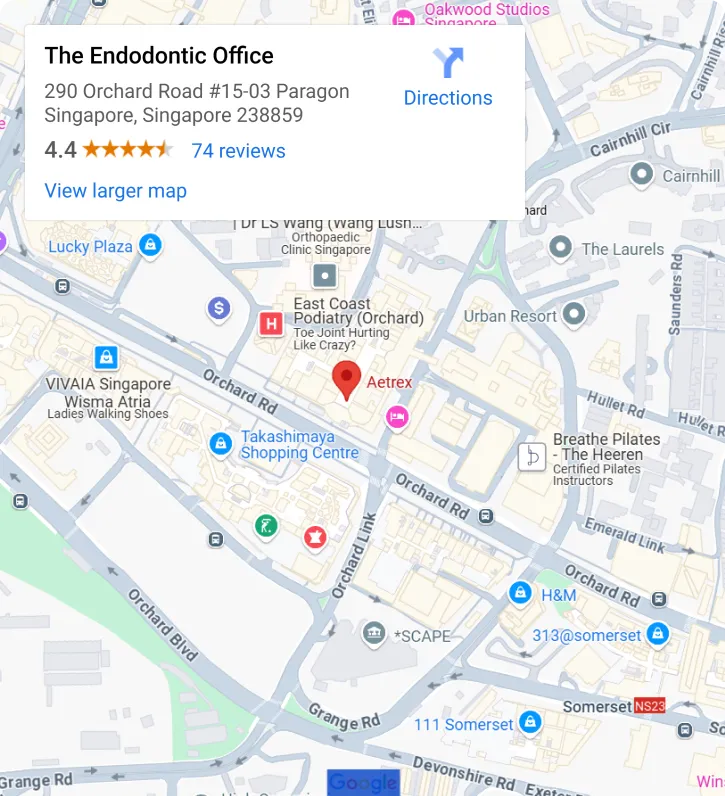


Orchard, Paragon Medical
Address: 290 Orchard Road, #15-03, Paragon, Singapore 238859
Phone: +65 6734 7790
WhatsApp: +65 9782 8446
Email: appointment@endooffices.com

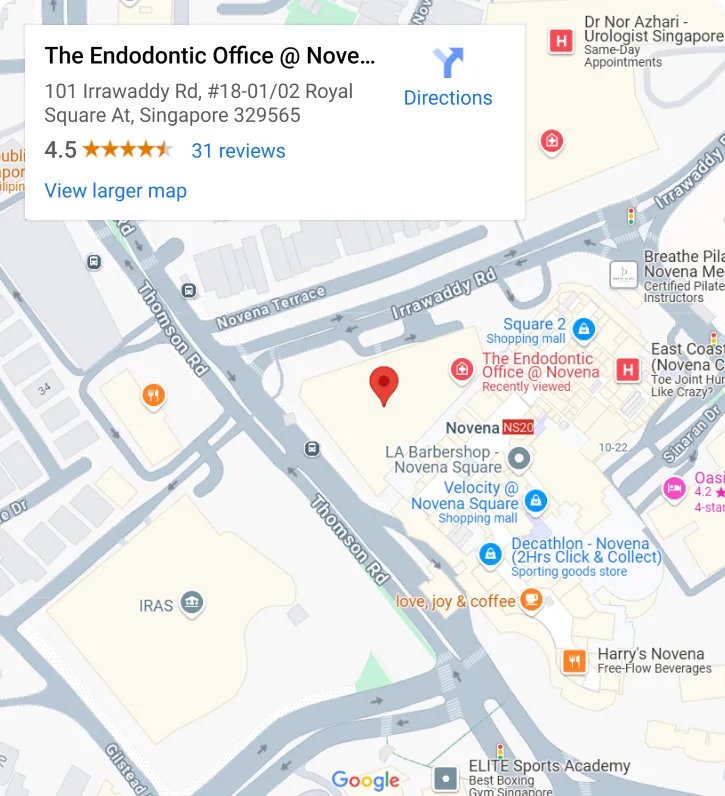
Novena, Royal Square Medical Centre
Address: 101 Irrawaddy Road, #18-01/02, Royal Square, Singapore 329565
Phone: +65 6259 3100
WhatsApp: +65 8078 9638
Email: appointment@endooffices.com

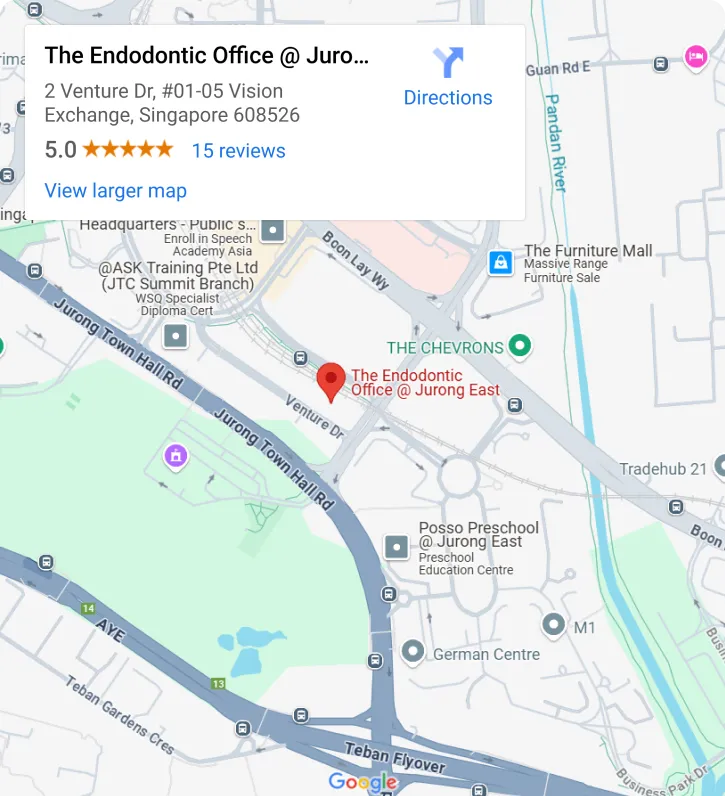
Jurong East, Vision Exchange
Address: 2 Venture Drive, #01-05, Vision Exchange, Singapore 608526
Phone: +65 6874 7790
WhatsApp: +65 8076 1813
Email: appointment@endooffices.com
The Endodontic Office is a trusted specialist dental practice in Singapore focused on advanced root canal treatment, effective dental pain relief, and preserving natural teeth through modern technology and expert care.

©2026 The Endodontic Office | All Rights reserved | Privacy Policy | Digital Marketing by Remedo